



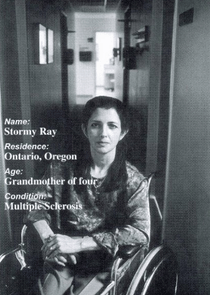
Stormy Ray, Chief Executive: Founder: President Emerita and Co-Petitioner of Meas. 67
Stormy Gayle Ray is a pioneering cannabis advocate best known as the Co-Petitioner of Measure 67, which led to the passage of the Oregon Medical Marijuana Act (OMMA) and the establishment of the Oregon Medical Marijuana Program (OMMP) in 1998. Working in coordination with Dr. Rick Bayer and respected industry leaders—including Jack Herer, John Sajo, Leland Berger, D. Paul Stanford, Laird Funk, Michael Mullins, Jennifer Valley, Walter R. “Rod” Hagen, and Richard Grant—Ray helped lay the structural foundation for Oregon’s medical cannabis framework.
Many of those collaborators went on to lead influential organizations of their own, solidifying the Stormy Ray Cardholders’ Foundation (SRCF) as one of the original incubators of the modern medical cannabis movement.
A staunch advocate for disability rights, awareness, and patient education, Ray has paved the way for countless individuals—both directly through advocacy and indirectly by establishing a model others would follow.

Jerry Wade, President: Secretary Emeritus: Patient Advocate and SB-1085 Leadership
Jerry Wade has consistently served the Stormy Ray Cardholders’ Foundation (SRCF) in senior leadership roles, including Director of Production, Board Secretary, and President. He is also a tenured researcher with the Cannalogix Foundation Research Institute (CFRI), where he continues to evaluate, analyze, and help shape medical cannabis policy at a national level while serving as both a consultant and board member of SRCF.
Wade was instrumental in the drafting and passage of SB-1085 in 2005, emerging during that period as one of the most influential and respected advocates in a decade that reshaped medical cannabis policy in Oregon and beyond.
An ethics-driven leader and mentor, Wade played a formative role in guiding multiple thought leaders within the cannabis space. Among those he mentored is the current SRCF Board Secretary and Vice President and Director of Research, James B. “J.B.” Creel. That mentorship helped extend SRCF’s influence nationally through Creel’s subsequent leadership roles with Compassion Center, the Coalition for Patient Rights, and the Integrative Providers Association.

James “J.B.” Creel, Board Secretary, V.P. and Director of Research and Development
James Braxton Creel is a researcher, compliance executive, and patient-rights advocate who has worked at the intersection of medical cannabis policy, organizational governance, and healthcare systems for more than two decades. He entered the medical cannabis space in 1999, during a period when advocacy, research, and compliance all carried significant personal and professional risk.
Creel rose through the ranks of the Stormy Ray Cardholders’ Foundation (SRCF), serving first as a volunteer, then as a proxy for his mother, Elizabeth W. Guilfoy, an SRCF Board Member. Those optics led to his work as a law-enforcement liaison, then compliance officer, and compliance manager, before being appointed to Board Secretary. In parallel, while he was working hard to keep the organization in alignment, he was working with his mother becoming a tenured researcher with her research institute, the Cannalogix Foundation Research Institute (CFRI) and then later Vice President and Director of Research & Development for the Cannalogix Foundation Research Institute (CFRI), where his work has focused on plant-based medicines, individualized profiling and genomics, policy analysis, systems design, and scalable compliance models.
While he still serves the SRCF, on a full time basis Creel is currently serving as the Board Secretary-Treasurer for the Compassion Center, one of the nation’s longest-standing nonprofit medical cannabis clinic systems serving patients in more than 18 states. Mr. Creel also works as Board Secretary for the Integrative Providers Association and the National Coalition for Patient Rights. He also serves as the Research Administrator for the Center for Incubation & Findings Research (CIFR), where he helps oversee their applied research initiatives and the Community-Based Clinical Cannabis Evaluation & Research Network (CBCCERN).
Known for his ethics-driven approach to leadership, and problem solving, Creel focuses on building durable systems that outlast individuals—prioritizing accountability, clarity of authority, and measurable outcomes over the optics. His work emphasizes patient dignity, regulatory coherence, and the quiet execution required to translate policy into practice.